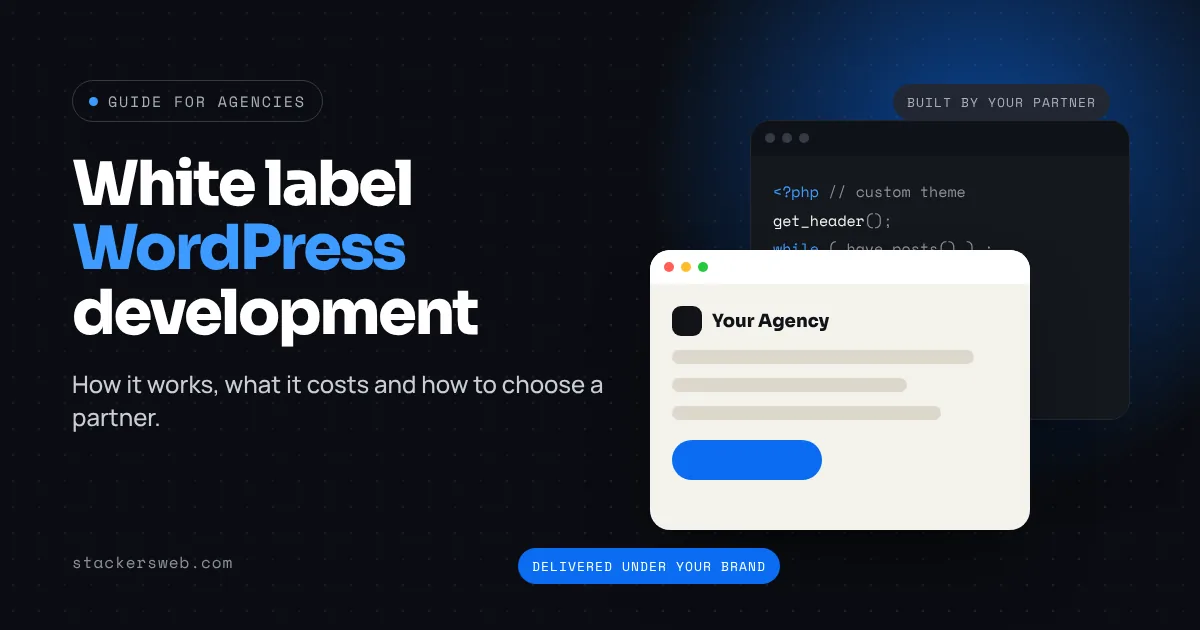
Quick answer: White label WordPress development means a partner builds WordPress websites that your agency sells and delivers under its own brand. Your agency keeps the client and the relationship, and the partner does the design build, development and testing quietly in the background.
Your agency is selling more websites than your team can build. Deadlines slip, your best developer is stretched across five projects, and hiring another full time developer feels like a big risk for work that comes in waves. This is the exact problem that white label WordPress development for agencies is meant to solve.
In this guide we explain how it works in practice, what it usually costs, where it goes wrong and how to choose a partner you can trust with your clients. We write this as a team that builds white label WordPress websites for agencies every week, so the advice comes from real projects.
What white label WordPress development means
A white label partner is a development team that works for your agency, not for your client. You sell the project, manage the client and send the requirements. The partner builds the website, and you deliver it as your own work.
Your client never sees the partner’s name. There is no partner logo in the footer, no partner email in the conversation and no partner name in the code or the WordPress admin. From the client’s side, your agency built the site.
This is different from normal freelancing. A freelancer often wants their own client relationship and their own portfolio credit. A white label partner is built around staying invisible and making your agency look good.
What a partner usually handles
- Turning Figma, XD or PSD designs into WordPress themes or page builder layouts
- Custom WordPress themes and plugins, including ACF and custom post types
- WooCommerce stores, payment gateways and product setup
- Speed optimization and technical SEO fixes
- Website migrations and redesigns of older sites
- Ongoing maintenance, updates and small change requests
How a white label WordPress project works step by step
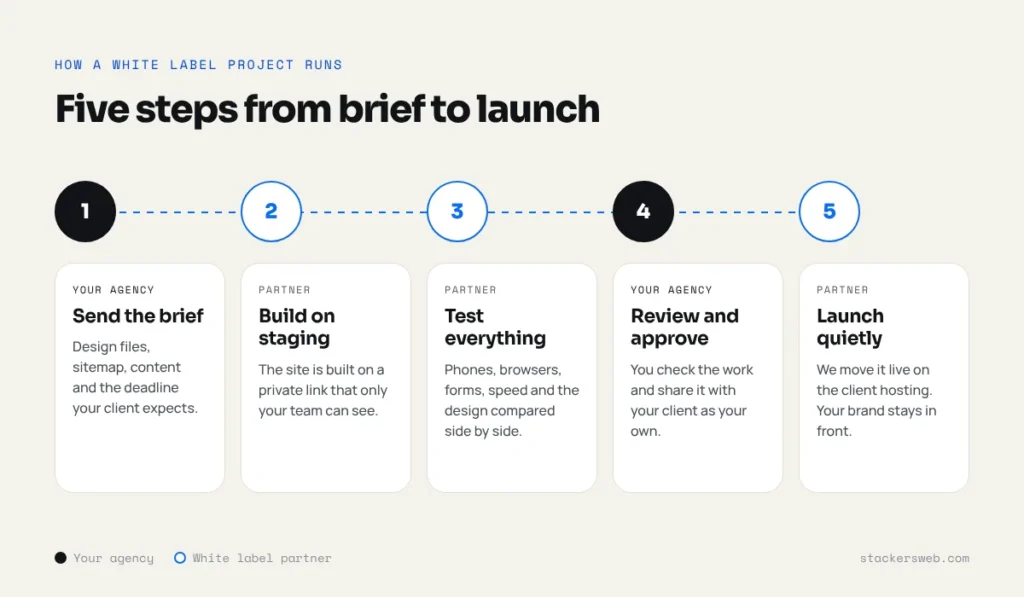
Every partner works a little differently, but good white label WordPress development for agencies usually follows a process like this.
- You send the brief. Design files, a sitemap, content, any plugins the client already uses and the date your client expects.
- The partner confirms scope and price. You should get a clear written quote and a timeline before any work starts. Questions come back to you, never to your client.
- The site is built on staging. The partner builds on a private staging link, so nothing touches the live site or the client’s hosting yet.
- Testing. The partner checks the site on phones, tablets and common browsers, tests every form, compares the build to the design and checks page speed.
- Your review. Your team reviews the staging site, asks for changes, then shares it with your client as your own work.
- Launch. The partner moves the site to the client hosting, sets up redirects if it is a redesign and checks everything again after launch.
Most agencies use their own project tool and their own Slack or email for this. A good partner fits into your tools instead of asking you to learn theirs.
Why agencies use white label WordPress development
The main reason agencies choose white label WordPress development is simple: it lets you sell more work without carrying the cost of a bigger team when work is slow.
- Flexible capacity. You can say yes to a busy month without hiring, and you do not pay salaries in a quiet month.
- Skills you do not have in house. Your designers may be strong, but a complex WooCommerce build or a custom plugin needs a developer who does that work every day.
- Better margins. You set the price for your client. The difference between your price and the partner’s price is your margin for strategy, design and client management.
- More time for selling. Your team can spend time on clients, sales and strategy instead of fixing plugin conflicts at midnight.
White label WordPress pricing models
Partners usually work in one of three ways. The right one depends on how steady your work is.
| Model | How it works | Best for |
|---|---|---|
| Fixed price per project | A quote for each website based on pages, features and design | Agencies with occasional builds |
| Monthly retainer | A set number of hours or a dedicated developer each month | Agencies with steady work every month |
| Hourly | You pay for the hours used, tracked and reported | Small fixes, maintenance and unclear scopes |
Be careful with prices that look far below everyone else. Very cheap builds often skip testing, use heavy themes with dozens of plugins or come back with problems after launch. Those problems land on your agency, because your name is on the work.
The risks and how to avoid them
White label work only works when you can trust the partner. These are the problems we hear about most often from agencies that switched to us, and how to protect yourself.
Poor communication
If you wait two days for every answer, the project will slip. Agree on response times and on how often you get progress updates before you start. A time zone difference can help here, because work moves forward while your team sleeps, but only if updates are clear and regular.
Quality that does not match the design
Ask for a pixel check against the design and testing on real devices. Ask to see live sites the partner has built, and open them on your phone.
The partner contacting your client
A professional partner never contacts your client directly. Put this in writing, together with a simple non disclosure agreement if you want extra peace of mind.
Code you cannot maintain later
Ask how the partner builds sites. Clean code, a theme that follows WordPress theme standards and a short handover note make it easy for anyone to maintain the site later.
How to choose a white label WordPress partner
Choosing the right partner matters more than anything else in white label WordPress development for agencies. Before you send real client work, ask these questions:
- Can you show live websites you built, not only screenshots?
- Who exactly will work on my projects, and how do we talk to them?
- How do you test a site before you hand it over?
- Do you build with a page builder, a custom theme or both, and why?
- What happens if I find a problem after launch?
- Will you sign an NDA and agree never to contact my clients?
Then start small. Send one real but low risk project first, such as a five page site or a list of fixes on an existing site. You will learn more from one small project than from any sales call.
If you want to see the kind of work a partner like us delivers, you can look through our WordPress projects. Many of the websites we build for agencies cannot be shown publicly, which is exactly how white label work should be.
Is white label WordPress development for agencies right for you?
It is usually a good fit if your agency sells websites regularly, your team is close to full, or clients ask for features your team does not build often. It may not be the right fit if you only build one or two simple sites a year, or if your whole offer depends on in house development as a selling point.
Many agencies start with overflow work only. When the partner proves reliable, they move to a monthly arrangement and plan their sales around the extra capacity. You can read how we run this in our white label WordPress development service.
FAQ
Will my client know I used a white label partner?
No. The partner works under your brand, communicates only with your team and leaves no partner name in the website, the code or the WordPress admin.
Who owns the website and the code?
Your client, through your agency, once the project is paid. Make sure your agreement with the partner says this clearly.
How long does a white label WordPress website take?
A simple business website often takes one to three weeks from approved design to launch. Larger sites, custom features and WooCommerce stores take longer. The partner should give you a timeline with the quote.
Can a white label partner also handle maintenance?
Yes. Many agencies sell monthly care plans to their clients and let the partner handle updates, backups, security checks and small edits behind the scenes. See our WordPress maintenance page for how that works.
Talk to us about your next project
If your agency has more WordPress work than your team can handle, we are happy to help. Send us one project, a design or even a short list of fixes, and we will reply with a clear quote and timeline. Tell us about your project and we will take it from there.